Low and Slow at Home: What Barbecue Actually Asks of You
The first time a brisket stalls, most people assume the smoker has died. The thermometer climbs steadily for six hours, reaches about 68C, then simply stops. It can sit there another four hours without moving a degree.
Nothing is wrong. That is low and slow barbecue behaving exactly as it should, and it is the moment most first attempts get ruined by someone deciding to fix it. Here is what the cook genuinely demands, what the guides tend to gloss over, and the point at which the sensible answer is to let a commercial pit do the work.
The clock is the ingredient you cannot buy
Everything else about barbecue is negotiable. Rub, wood, smoker design, whether you spritz. Time is not.
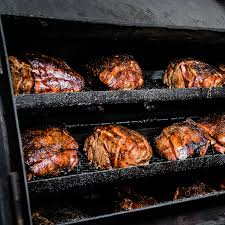
At around 107C, a whole packer brisket runs roughly two to three hours a kilo, which puts a five kilo piece somewhere between twelve and eighteen hours before it is even ready to rest. That range is not vagueness. Two briskets of identical weight can finish four hours apart depending on thickness, fat content and how humid the chamber runs.
So the planning rule is simple and almost nobody follows it: work backwards from when you want to eat, then add four hours of slack you expect to waste. A brisket that finishes early can be held. One that finishes late cannot be hurried, and you will be feeding twelve people crisps at 9:00pm.
The stall is physics, not a fault
Somewhere between 65C and 74C internal, the meat starts sweating faster than the heat can push it along. The moisture evaporating off the surface cools it at almost exactly the rate the smoker warms it, and the two cancel out. That plateau typically holds for two to six hours.
You have two honest options. Wait it out, which gives you the best bark and the least control over your timings. Or wrap once the bark has set, usually around 74C, in butcher paper or foil, which cuts the stall short at the cost of some crust.
What you must not do is chase it. Opening the lid to check, spritzing heavily, or winding the temperature up mid stall are the three reliable ways to make the plateau longer rather than shorter. Every lid lift costs you heat and adds time.
read more : https://cubanribs.com/
Where a backyard cook and a commercial pit part ways
This is the part the home guides leave out, and it explains why restaurant brisket is more consistent than yours.
A venue does not try to time the cook to service. It cooks the meat until it is done, whenever that happens, then holds it at a stable temperature for hours until it is needed. The unpredictability is absorbed by the holding stage instead of being passed to the diner. That is a piece of equipment and a roster, not a technique, and it is not something you can replicate with an esky and good intentions.
Which is the honest case for not lighting the smoker at all. If you are cooking for four on a weeknight, or you want brisket on a specific evening at a specific hour, the maths does not work. A place like Elements Smokehouse in Darlinghurst runs beef brisket, beef back ribs and brisket burnt ends every night of the week precisely because the hard part has already been solved off the clock. Cook at home when the day is the point. Book a table when the meal is the point.
Doneness is a feel, not a number
Every guide gives you a target of roughly 90C to 96C, and every guide is telling you a half truth. Two briskets can hit 94C with one probing like soft butter and the other still tight.
The number tells you when to start checking. The probe tells you when to stop. Slide a thermometer probe into the thickest part of the point and it should meet almost no resistance, the way it would going into room temperature butter. Resistance means it needs longer, whatever the display says.
Connective tissue is the reason. Collagen needs both temperature and time to break down into gelatin, and time is the variable a thermometer cannot see.
The rest is part of the cook, not the clean up
Slicing straight off the smoker undoes the previous fourteen hours. The juices are still mobile, they run onto the board, and the meat reads as dry even though it was cooked perfectly.
An hour is the minimum. Two to four hours, wrapped and sitting in a dry, empty cooler, is better and is what most competition cooks do. It holds safely hot for a long time and buys back some of the timing control the stall took from you.
Then slice against the grain, and check which way it runs before you cut, because it changes direction between the flat and the point.
If you are booking rather than cooking
Restaurant barbecue has its own fine print, and it catches people out about as reliably as the stall does.
Two rules are close to universal. Weeknight deals are almost never valid on public holidays or special event days, so do not build a plan around one without checking. And they tend to be capped at small tables: the specials they run through the week at Elements Smokehouse on Palmer Street are limited to bookings of up to six guests, with larger groups ordering from the full menu instead. Anything billed as unlimited usually needs pre-payment when you book and will not be honoured for walk-ins.
Three things worth knowing before your first attempt
- Buy bigger than feels sensible. A small brisket cooks faster and dries out far more easily, and the trim takes more off than you expect.
- Do not wrap before the bark has set. Wrapping early keeps moisture in and softens the crust you have not finished building.
- Do not plan an event around it. Cook the brisket the day before if the date is fixed, then reheat gently. Every experienced cook learned this the expensive way.
None of that is meant to talk anyone out of it. A first brisket is usually better than people expect, and the failures are predictable rather than mysterious.
It is worth knowing what you are signing up for before you buy five kilos of beef on a Friday afternoon. Fourteen hours is a long time to find out you needed sixteen.